









Best AC for Solar Systems in Pakistan

Complete Buying Guide
Choosing the best AC for a solar system in Pakistan has become increasingly important as electricity prices continue to put pressure on household and business budgets. Solar power can significantly reduce dependence on the national grid, but the air conditioner you choose plays a major role in how effectively your solar system performs.
An air conditioner is one of the highest electricity-consuming appliances in many Pakistani homes, especially during the summer months. This is why homeowners who have installed solar panels often look for an AC that can deliver powerful cooling while keeping electricity consumption under control.
However, buying an AC for solar use is not simply about choosing the lowest-wattage model. You need to consider the AC’s inverter technology, cooling capacity, energy efficiency, compressor performance, operating range, room size, sunlight exposure, and compatibility with your overall solar setup.
If you are searching for the best inverter AC for solar panels in Pakistan, this guide will help you understand what to look for before making a purchase.
KiaChahiye.com makes it easier for customers in Pakistan to explore different home appliances and compare suitable options according to their requirements. With delivery available across Pakistan, you can explore AC options online without limiting yourself to local market availability.
Why Choose an AC for a Solar System?
Solar energy and inverter air conditioners can work particularly well together because both technologies are designed around better energy management.
Traditional fixed-speed air conditioners generally operate at full capacity whenever the compressor is running. Once the desired temperature is reached, the compressor switches off, and it starts again when cooling is required.
An inverter AC works differently. It can adjust compressor speed according to the cooling requirement. Instead of continuously operating at maximum capacity, it can reduce its output when the room approaches the desired temperature.
This can make inverter ACs a particularly attractive choice for homes using solar power.
During sunny hours, solar panels can produce substantial electricity, and an efficient inverter AC can use that available energy more intelligently. When solar generation is lower, the system can rely more heavily on batteries or the electricity grid, depending on how the solar installation is configured.
For this reason, the best AC for solar systems in Pakistan is generally an energy-efficient inverter model rather than a conventional non-inverter AC.
What Makes an AC Suitable for Solar Power?
There are several characteristics that make one AC more suitable for solar use than another.
1. Inverter Technology
The first feature to look for is DC inverter or advanced inverter technology.
Inverter ACs can vary compressor speed according to the cooling demand. This can reduce unnecessary power consumption compared with conventional fixed-speed air conditioners.
For solar-powered homes, this flexibility can be particularly useful because solar electricity production can vary throughout the day.
A good inverter AC can operate at lower power once the room has reached a comfortable temperature rather than continuously running at maximum capacity.
2. High Energy Efficiency
Energy efficiency should be one of the most important factors when selecting an AC for solar use.
An AC that provides strong cooling while consuming less electricity can make better use of your available solar generation.
When comparing models, look for energy-efficiency information provided by the manufacturer. Some ACs are designed specifically for low-energy operation and may include multiple energy-saving modes.
Energy efficiency becomes even more important if you operate the AC for many hours every day.
3. T3 Compressor Technology
Pakistan experiences extremely hot summers, particularly in cities such as Karachi, Lahore, Multan, Faisalabad, Islamabad, Rawalpindi, Hyderabad, and other areas.
High outdoor temperatures can put additional pressure on an air conditioner’s compressor.
This is where T3 compressor technology can become important.
T3-rated ACs are designed to perform in high-temperature environments. Depending on the model and manufacturer specifications, they may provide more reliable cooling when outdoor temperatures become extremely high.
If you live in a particularly hot region of Pakistan, a T3 inverter AC can be a strong option for solar-powered operation.
However, T3 technology alone does not automatically mean that an AC is the most energy efficient. You should still compare its overall energy performance.
Best AC Capacity for Solar Systems
Choosing the correct AC capacity is just as important as selecting the right technology.
An AC that is too small for the room may have to work continuously to maintain the desired temperature. This can increase electricity consumption and reduce comfort.
On the other hand, an AC that is unnecessarily large may cool the room quickly but can also result in inefficient operation and higher upfront costs.
The most common AC capacities in Pakistan include:
- 1 Ton
- 1.5 Ton
- 2 Ton
- 2.5 Ton
- 3 Ton
The right capacity depends on room size, ceiling height, number of windows, sunlight exposure, insulation, number of occupants, and heat generated by appliances.
Is a 1 Ton AC Good for Solar?
A 1 ton inverter AC can be an excellent option for smaller bedrooms, study rooms, offices, and other compact spaces.
If the room is properly insulated and does not receive excessive direct sunlight, a 1 ton inverter AC may provide sufficient cooling without placing unnecessary demand on your solar system.
For users with smaller solar installations, selecting a properly sized 1 ton inverter AC can be a practical solution.
However, room size should always be considered before purchasing.
Do not choose a 1 ton AC simply because it consumes less electricity. If the room requires more cooling capacity, an undersized AC may operate for longer periods and fail to provide satisfactory comfort.
Is a 1.5 Ton AC Good for Solar?
A 1.5 ton inverter AC is one of the most popular choices for Pakistani homes.
It is commonly used in medium-sized bedrooms, living rooms, offices, and family spaces.
For many households, a 1.5 ton inverter AC provides a good balance between cooling capacity and energy efficiency.
If you have a reasonably sized solar system and want to operate your AC during the daytime, a highly efficient 1.5 ton inverter AC can be an excellent choice.
This capacity is particularly popular because it offers enough cooling for many common residential rooms without requiring the electricity demand of a much larger AC.
Is a 2 Ton AC Suitable for Solar?
A 2 ton inverter AC is generally suitable for larger rooms, lounges, drawing rooms, and commercial spaces.
Because it has a higher cooling capacity, it will naturally require more electricity than a smaller AC when operating under similar conditions.
However, a high-efficiency 2 ton inverter AC can still work effectively with a properly designed solar system.
If you are planning to power a 2 ton AC primarily through solar energy, your complete solar setup needs to be designed around the expected electrical load.
The goal should not simply be to install a large solar system and then choose any AC. Instead, the AC and solar system should be considered together.
Inverter AC vs Non-Inverter AC for Solar
If your primary goal is to reduce electricity consumption through solar energy, an inverter AC is generally a better choice.
Inverter AC
An inverter AC can adjust compressor speed according to cooling demand.
Advantages include:
- Better energy management
- Variable compressor operation
- Potentially lower electricity consumption
- More consistent room temperature
- Better suitability for long operating hours
- Excellent compatibility with solar-powered homes
Non-Inverter AC
A conventional non-inverter AC generally operates the compressor at a fixed speed.
It may cost less initially, but its operating pattern can make it less attractive for users who want maximum energy efficiency.
For a solar-powered home, an inverter AC is usually the more practical long-term option.
DC Inverter AC for Solar Systems
DC inverter technology is particularly relevant when choosing an AC for solar use.
A DC inverter AC can continuously adjust compressor operation based on the cooling requirement. This allows the AC to reduce its power demand when full cooling is no longer necessary.
This can be beneficial when solar production changes during the day.
For example, solar generation may be lower in the morning, reach higher levels around midday, and then decrease during the afternoon. An efficient inverter AC can adjust its operation according to the cooling requirement rather than always operating at maximum power.
This does not mean that every DC inverter AC will use the same amount of electricity. Performance varies from model to model.
Always compare the specifications and efficiency ratings before purchasing.
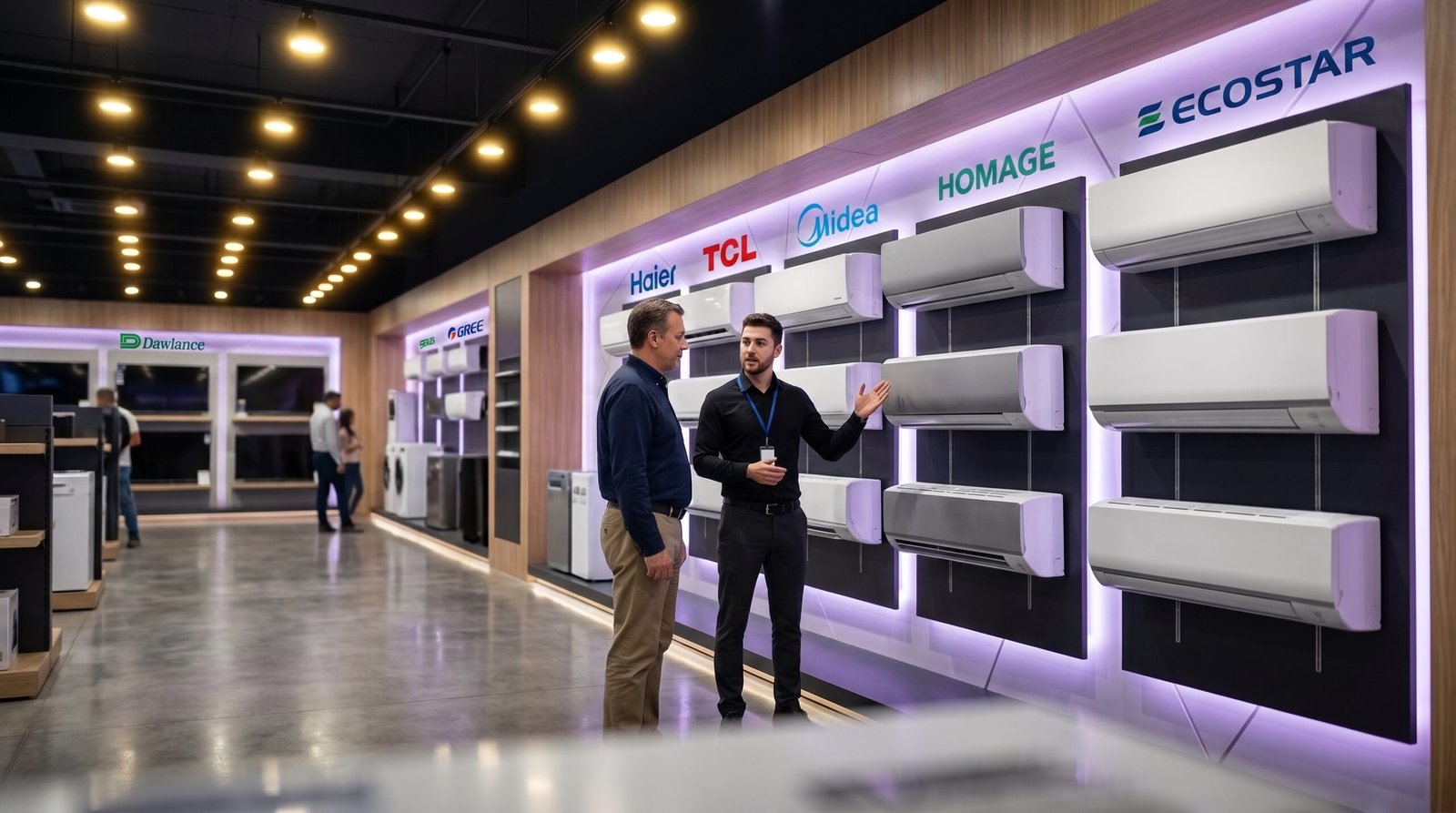
AC Brands to Consider for Solar Systems in Pakistan
Pakistan’s air conditioner market includes several major brands offering inverter models.
Some commonly considered brands include:
- TCL
- Haier
- Dawlance
- Gree
- Orient
- PEL
- Midea
- Kenwood
- EcoStar
Each brand offers different models, capacities, features, compressor technologies, and price points.
Instead of choosing a brand only because it is popular, compare the actual model according to your room requirements and energy-efficiency needs.
A premium AC with advanced features may not necessarily be the best choice for every home. Similarly, a budget AC may not provide the performance required for a large room or extremely hot location.
TCL ACs for Solar Systems
TCL offers a range of inverter air conditioners designed for residential cooling.
Many TCL models focus on energy efficiency, inverter operation, fast cooling, and smart features.
For solar users, TCL inverter models can be worth considering when looking for an AC that combines modern features with energy-conscious operation.
When comparing TCL models, pay attention to the AC’s capacity, compressor technology, energy-saving modes, operating temperature range, and warranty.
Haier ACs for Solar Systems
Haier is another well-known appliance brand in Pakistan with a broad range of air conditioners.
Haier inverter ACs are available in different capacities and feature combinations.
Some models are designed for high-temperature environments and may include technologies intended to maintain cooling performance during extreme weather.
If you are considering Haier for a solar system, compare the model’s actual power consumption and efficiency specifications rather than selecting only on the basis of brand name.
Dawlance ACs for Solar Systems
Dawlance offers various inverter air conditioners for Pakistani households.
The brand has models designed for different room sizes and cooling requirements.
For solar users, Dawlance inverter models may be worth evaluating based on energy efficiency, compressor technology, cooling performance, and operating range.
If you are purchasing an AC for a solar-powered home, look beyond the initial price and consider how efficiently the model can operate over extended periods.
Gree ACs for Solar Systems
Gree is another popular air conditioner brand in Pakistan.
Gree offers inverter ACs in multiple capacities, including models designed for hot climates.
For consumers looking for a solar-compatible AC, Gree models can be compared based on inverter technology, compressor type, energy efficiency, cooling capacity, and operating performance.
As with any brand, the exact model specifications matter more than the brand name alone.
Orient ACs for Solar Systems
Orient offers a wide selection of inverter air conditioners in Pakistan.
Many Orient AC models focus on energy saving, rapid cooling, and operation in hot weather.
If you are considering an Orient inverter AC for a solar setup, compare the model’s energy performance and cooling capacity with similar products from other brands.
A proper comparison can help you identify the model that best fits your electricity usage and solar capacity.
PEL ACs for Solar Systems
PEL is another established Pakistani appliance brand offering air conditioning solutions.
PEL inverter ACs are available in different capacities and price ranges.
For customers looking for a practical option for solar-powered homes, PEL models can be compared based on inverter technology, cooling capacity, energy consumption, warranty, and service support.
Midea ACs for Solar Systems
Midea has become another option for Pakistani consumers looking for modern inverter air conditioners.
Its AC range includes different capacities and feature combinations.
Solar users should focus on energy efficiency, inverter operation, cooling performance, and high-temperature capability when evaluating Midea models.
How Many Solar Panels Are Needed for an AC?
One of the most common questions from solar users is how many panels are needed to operate an AC.
There is no single answer because the requirement depends on several factors.
These include:
- AC capacity
- AC efficiency
- Actual compressor power consumption
- Solar panel capacity
- Solar panel efficiency
- Weather conditions
- Time of day
- Solar system configuration
- Other appliances operating at the same time
- Battery availability
- Grid availability
A solar system designed only for daytime AC operation can be different from a system designed to operate the AC throughout the night.
Therefore, it is important to consider the complete household load rather than focusing only on the AC.
Can a 1.5 Ton Inverter AC Run on Solar?
Yes, a 1.5 ton inverter AC can run on solar power when the solar system is properly designed to handle its electrical demand.
This is one of the most practical combinations for many Pakistani homes.
During strong sunlight, solar panels can provide electricity to the home while the AC operates. If the solar system produces more power than the home requires, the excess may be exported to the grid or stored in batteries, depending on the setup.
When solar production drops, the AC may draw power from batteries or the grid.
The important point is that the solar system should be designed according to the actual electrical requirements of the AC and other appliances in the home.
Can an AC Run Directly on Solar Panels?
In most residential setups, an AC is not simply connected directly to solar panels.
A proper solar installation normally includes appropriate power electronics such as an inverter and may also include batteries depending on the system.
Solar panels generate DC electricity, while most household air conditioners require AC electricity.
The solar inverter manages the conversion and distribution of electricity.
Some specialized solar air conditioning systems are designed differently, but for a typical Pakistani home, a properly installed solar power system is the safer and more practical approach.
On-Grid vs Hybrid Solar for AC
When planning to operate an AC with solar energy, you may need to choose between different solar system configurations.
On-Grid Solar System
An on-grid system works alongside the electricity grid.
During daylight hours, solar energy can power household appliances, including the AC. Depending on the system and applicable arrangements, excess energy may be supplied to the grid.
One major limitation is that standard on-grid systems generally shut down during a grid outage for safety reasons.
Hybrid Solar System
A hybrid system can combine solar panels, batteries, and the grid.
This can provide more flexibility.
If solar production decreases, batteries can support the household load. If battery capacity becomes low, the system can use grid electricity depending on the setup.
For households that want greater flexibility in operating an AC, a hybrid system can be an attractive option.
Should You Use Batteries for AC?
Batteries can provide backup power, but they also increase the cost of a solar installation.
If your main goal is to operate the AC during sunny daytime hours, you may not require a large battery system.
However, if you want the AC to continue running during the evening or during power outages, batteries become much more important.
Air conditioners can consume significant electricity over extended periods, so battery capacity needs to be planned carefully.
Lithium batteries are increasingly considered for solar applications because of their performance and lifecycle advantages, although the overall cost can be higher.
Before purchasing batteries, consider how often you experience load shedding and how long you want your AC to operate without grid power.
Best Time to Run AC on Solar
The strongest solar generation usually occurs during the middle part of the day.
This makes daytime an excellent period for using solar power-intensive appliances such as air conditioners.
However, Pakistan’s hottest weather can sometimes continue into the afternoon and evening.
A smart approach is to use the AC efficiently throughout the day while taking advantage of available solar energy.
You can also use energy-saving modes, maintain a reasonable temperature setting, keep doors and windows closed, and ensure that filters remain clean.
These simple practices can improve cooling efficiency without requiring changes to your solar system.
How to Reduce AC Electricity Consumption on Solar
Installing solar panels does not mean electricity consumption should be ignored.
The less electricity your AC consumes, the smaller the solar system required to support your overall household load.
Here are some practical ways to improve efficiency.
Keep the AC Temperature Reasonable
Setting the AC to an extremely low temperature does not necessarily cool the room faster.
A reasonable temperature can provide comfortable cooling while reducing unnecessary compressor operation.
Clean the Filters
Dirty filters can restrict airflow and force the AC to work harder.
Cleaning the indoor unit filters regularly can help maintain airflow and cooling performance.
Keep Doors and Windows Closed
If cooled air constantly escapes from the room, the AC has to operate longer.
Keep doors and windows closed while the AC is running.
Use Curtains or Blinds
Direct sunlight can significantly increase indoor heat.
Curtains, blinds, and shades can reduce heat entering the room and make it easier for the AC to maintain a comfortable temperature.
Maintain the Outdoor Unit
The outdoor unit needs sufficient airflow.
Avoid covering it with objects or placing it in a location where airflow is restricted.
Regular professional maintenance can also help maintain performance.
AC Efficiency Matters More Than Just Solar Capacity
Many people make the mistake of focusing entirely on solar panel capacity.
For example, they may think that installing more solar panels automatically solves their electricity consumption problem.
However, improving appliance efficiency can be equally important.
An efficient inverter AC can reduce the electrical load placed on the solar system.
This means you may be able to use your available solar generation more effectively for other appliances such as refrigerators, washing machines, water pumps, televisions, lights, and fans.
Therefore, when buying an AC, always consider both cooling performance and energy efficiency.
Solar-Friendly AC Features to Look For
When searching for the best AC for a solar system in Pakistan, consider the following features:
DC Inverter Technology
This is one of the most important features for energy-conscious users.
High Energy Efficiency
Look for models designed to provide efficient cooling with controlled electricity consumption.
T3 Compressor
Useful for homes located in areas with very high summer temperatures.
Energy-Saving Mode
A dedicated energy-saving mode can help reduce unnecessary power consumption.
Sleep Mode
Sleep mode can automatically adjust operation for nighttime comfort and efficiency.
Low Voltage Operation
Some inverter ACs are designed to operate under unstable voltage conditions, which can be useful in areas with electricity fluctuations.
Turbo Cooling
Turbo mode can provide rapid cooling when you first enter a hot room, after which you can switch to a more efficient setting.
Smart Controls
Some modern ACs allow users to control temperature and operation through mobile applications or smart features.
Does T3 AC Consume More Electricity?
T3 refers primarily to the compressor’s ability to operate under high ambient temperature conditions.
It does not automatically mean that a T3 AC will consume more electricity than every T1 AC.
Actual electricity consumption depends on the model’s efficiency, capacity, operating conditions, insulation, room size, temperature setting, and usage duration.
For Pakistan’s extremely hot summer climate, a suitable T3 inverter AC can provide more reliable cooling under high outdoor temperatures.
The best approach is to compare the efficiency and specifications of individual models rather than judging them only by the T3 label.
Solar AC Buying Guide for Different Rooms
The ideal AC capacity depends heavily on the room.
Bedroom
For a typical bedroom, a 1 ton or 1.5 ton inverter AC may be suitable depending on the room size and heat exposure.
Large Bedroom
A larger bedroom may require a 1.5 ton model, particularly if it receives direct sunlight.
Living Room
Living rooms can require more cooling because they are often larger and may have more people using them.
A 1.5 ton or 2 ton inverter AC may be appropriate depending on the space.
Drawing Room
A larger drawing room may benefit from a 2 ton inverter AC or another suitable capacity based on its size.
Office
For offices, consider the number of employees, computers, lighting, windows, and room size.
The AC should be selected according to the total cooling requirement.
Important Factors for Karachi AC Buyers
Karachi has a hot and humid climate, which can make AC performance particularly important.
Humidity can affect comfort even when the temperature does not appear extremely high.
For Karachi households using solar power, an inverter AC designed for efficient cooling and suitable high-temperature operation can be a practical choice.
If the AC is being used for long hours, energy efficiency becomes even more important.
Customers in Karachi should also consider outdoor unit placement, ventilation, salt-laden coastal air, installation quality, and regular maintenance.
Important Factors for Lahore AC Buyers
Lahore experiences extremely hot summers, while temperatures can vary considerably throughout the year.
A heat and cool inverter AC can be useful for households that want both summer cooling and winter heating.
For solar users, the main focus should remain on inverter performance, energy efficiency, and suitability for high outdoor temperatures.
Proper insulation and shading can also make a noticeable difference in cooling performance.
Important Factors for Islamabad and Rawalpindi
Islamabad and Rawalpindi experience hot summers but also have cooler winters.
A heat and cool inverter AC can provide greater year-round usefulness.
If you are investing in solar power, selecting an efficient inverter AC can help reduce electricity consumption while providing both cooling and heating when required.
Important Factors for Multan and Other Hot Cities
Cities such as Multan can experience extremely high summer temperatures.
In such environments, compressor performance becomes particularly important.
A high-temperature-rated inverter AC can be a better option than a basic model that may struggle under extreme outdoor conditions.
When purchasing an AC for a solar system in a very hot city, prioritize reliable high-temperature operation along with energy efficiency.
Installation Quality Is Extremely Important
Even the best AC can perform poorly if it is installed incorrectly.
Professional installation is important for cooling performance, energy efficiency, and long-term reliability.
The indoor unit should be installed in a suitable location where air can circulate effectively.
The outdoor unit should have sufficient ventilation and should not be exposed to unnecessary restrictions.
Refrigerant piping should be installed properly, and the system should be checked carefully after installation.
Poor installation can result in weak cooling, excessive electricity consumption, water leakage, and other problems.
Insulation Can Improve Solar AC Performance
Room insulation is often overlooked when people calculate their AC requirements.
A poorly insulated room can lose cooled air quickly.
Heat can enter through:
- Windows
- Doors
- Roofs
- External walls
- Gaps around openings
Improving insulation can reduce the amount of work required from the AC.
This means the air conditioner may operate more efficiently and the solar system can support the household load more effectively.
For rooms under direct sunlight, curtains, reflective materials, shading, and proper insulation can make a significant difference.
How to Choose the Best AC for Your Solar System
Before purchasing an AC, ask yourself the following questions:
What is the room size?
Choose a capacity appropriate for the space rather than buying based only on price.
How many hours will the AC run?
If you use the AC for long periods, energy efficiency becomes even more important.
Do you already have solar panels?
If yes, check the capacity and configuration of your existing system.
Do you want to run the AC at night?
If yes, consider whether your batteries can support the additional load.
Is your area extremely hot?
If you live in a very hot region, consider a T3-rated inverter model.
Is the room properly insulated?
Better insulation can reduce cooling requirements.
Do you experience load shedding?
If yes, a hybrid solar system with suitable battery storage may be more appropriate.
Common Mistakes When Buying an AC for Solar
Many buyers make mistakes because they focus on only one factor.
Choosing AC Capacity Based Only on Price
A cheaper AC is not necessarily the best option.
Always consider the room size and cooling requirements.
Ignoring Inverter Technology
If energy efficiency is your priority, a non-inverter model may not be the best long-term choice.
Choosing a Model Without Considering Local Climate
An AC that works well in moderate temperatures may not perform the same way during extreme Pakistani summers.
Ignoring Installation
Incorrect installation can reduce the performance of even an excellent AC.
Focusing Only on Solar Panels
Your appliances also determine how much electricity your solar system needs to provide.
Ignoring Maintenance
Dirty filters and poorly maintained outdoor units can increase operating costs.
Which Is the Best AC for Solar Systems in Pakistan?
There is no single AC model that is perfect for every household.
The best AC for solar systems in Pakistan depends on your room size, solar capacity, daily usage, location, budget, and cooling requirements.
For smaller rooms, an efficient 1 ton inverter AC can be a practical choice.
For medium-sized rooms, a 1.5 ton inverter AC is often a strong option.
For larger rooms, lounges, or commercial spaces, a 2 ton inverter AC may be more suitable.
For areas with extremely high temperatures, consider a T3 inverter model.
Brands such as TCL, Haier, Dawlance, Gree, Orient, PEL, Midea, Kenwood, and EcoStar offer different inverter options that can be compared according to your requirements.
Instead of choosing a model solely based on brand or price, compare its cooling capacity, inverter technology, energy efficiency, compressor type, warranty, and suitability for your local climate.
Why Buy Your AC from KiaChahiye.com?
Finding the right AC can be difficult when there are so many brands, capacities, and models available in Pakistan.
KiaChahiye.com helps customers explore a wide range of electronics and home appliances online.
Whether you are looking for a 1 ton AC for a bedroom, a 1.5 ton AC for a medium-sized room, or a larger capacity model for a living area, comparing products before purchasing can help you make a more informed decision.
Before placing your order, always review the product specifications, available warranty, features, cooling capacity, and other relevant information.
Final Verdict
Solar energy can significantly change the way Pakistani households manage their electricity consumption, particularly when running high-power appliances such as air conditioners.
However, the success of a solar-powered AC setup depends on more than simply installing solar panels.
The AC itself should be energy efficient, correctly sized, and suitable for Pakistan’s climate.
For most households, an inverter AC is the preferred option because it can adjust compressor operation according to cooling demand. A T3 inverter AC can be particularly useful in regions that experience extreme summer temperatures.
A 1 ton model can work well for smaller rooms, while a 1.5 ton inverter AC can be an excellent choice for many medium-sized bedrooms and living spaces. Larger rooms may require 2 ton or higher capacities.
You should also consider whether you need an on-grid or hybrid solar system, whether batteries are required, and how many other appliances will operate alongside the AC.
The most important thing is to select the complete system according to your actual requirements.
Frequently Asked Questions (FAQs)
Q1. Which AC is best for solar systems in Pakistan? +
The best AC for a solar system in Pakistan is generally an energy-efficient inverter AC with suitable cooling capacity. A T3 inverter model can be particularly useful in areas with extremely high summer temperatures. The ideal model depends on room size, solar capacity, daily usage, and budget.
Q2. Is an inverter AC better for solar? +
Yes. An inverter AC is generally better suited to solar-powered homes because it can adjust compressor speed according to cooling demand. This can help manage electricity consumption more efficiently than a conventional fixed-speed AC.
Q3. Can a 1.5 ton AC run on solar? +
Yes, a 1.5 ton inverter AC can run on solar when the solar system is properly designed to support its electrical requirements. The overall solar capacity should also account for other appliances operating in the home.
Q4. Is T3 AC better for Pakistan? +
A T3 AC can be a good choice for Pakistan because many areas experience extremely high outdoor temperatures during summer. T3-rated models are designed for operation in high-temperature conditions, but buyers should still compare overall energy efficiency and performance.
Q5. Which AC consumes less electricity on solar? +
An efficient inverter AC generally consumes less electricity than a comparable conventional fixed-speed AC under similar operating conditions. Actual consumption depends on the model, room size, temperature, insulation, usage hours, and outdoor conditions.
Q6. Can I run my AC directly from solar panels? +
A typical household AC is normally not connected directly to solar panels. A suitable solar inverter and other necessary system components are generally required to convert and manage the electricity supplied by solar panels.
Q7. Do I need batteries to run AC on solar? +
Not necessarily. If you mainly want to operate your AC during daylight hours, you may be able to use solar power without a large battery system. Batteries become more useful when you want backup power or want to operate the AC after solar generation decreases.
Q8. Is a 1 ton AC suitable for solar? +
Yes. A 1 ton inverter AC can be a good choice for smaller rooms and can work well with a properly designed solar system. However, the AC capacity should always match the actual cooling requirement of the room.
Q9. Which AC brand is best for solar in Pakistan? +
There is no single best brand for every solar user. TCL, Haier, Dawlance, Gree, Orient, PEL, Midea, Kenwood, and EcoStar all offer different inverter AC models. Compare individual models based on energy efficiency, cooling capacity, compressor technology, warranty, and price.
Q10. Where can I buy an AC in Pakistan? +
You can explore different AC models through KiaChahiye.com, where customers can compare home appliances and electronics according to their requirements. KiaChahiye.com offers delivery across Pakistan, allowing customers in different cities to order their preferred products online.