








What is the Difference between R32 vs R410A AC Gas?

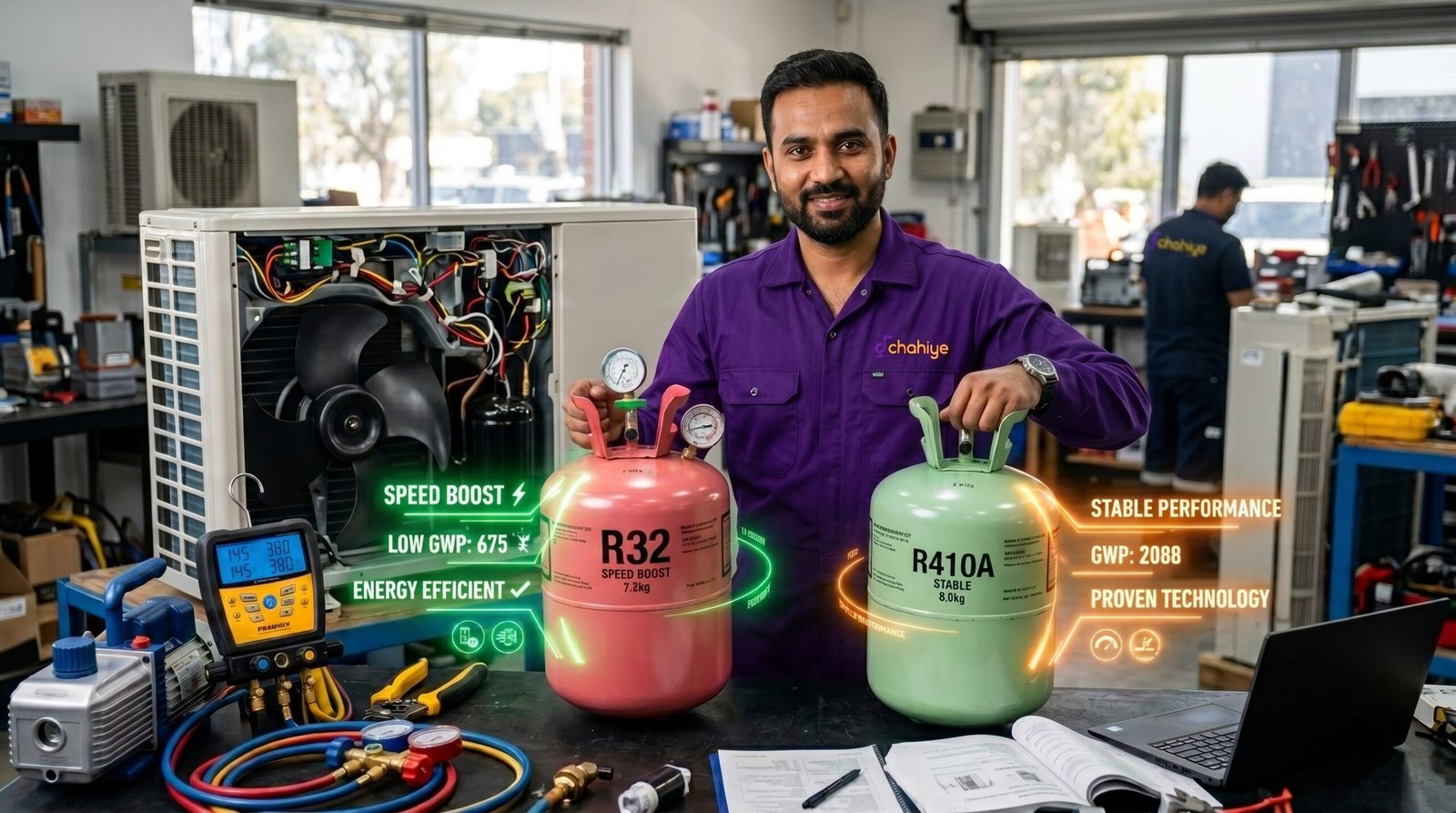
R32 vs R410A: Which AC Refrigerant Gas Is Better for Cooling and Electricity Savings?
Buying a new air conditioner is a major decision, especially in Pakistan, where summer temperatures can become extremely high. When comparing different air conditioner models, most buyers usually focus on the brand, tonnage, inverter technology, cooling capacity, price, and warranty. However, there is another important specification that is often overlooked: the AC refrigerant gas.
You may have seen terms such as R32 refrigerant and R410A refrigerant while checking air conditioners. But what do these terms actually mean? Is R32 better than R410A? Does R32 provide faster cooling? Can it reduce electricity consumption? Is R410A still a good option for an air conditioner?
The difference between R32 and R410A is important because refrigerant technology affects an air conditioner’s efficiency, environmental impact, servicing requirements, and overall performance.
In this detailed guide, we will explain R32 vs R410A in simple terms. You will learn how both refrigerants work, their major differences, cooling performance, energy efficiency, environmental impact, safety, servicing requirements, refrigerant costs, and which refrigerant is generally a better choice when buying a new AC in Pakistan.
What Is AC Refrigerant Gas?
Before comparing R32 and R410A, it is important to understand what refrigerant gas actually does inside an air conditioner.
An AC refrigerant is a special substance that moves heat from one place to another. In a cooling system, the refrigerant absorbs heat from the indoor air and transfers that heat to the outdoor environment.
This process is part of the refrigeration cycle, which involves several important components, including:
- Compressor
- Condenser
- Expansion device
- Evaporator
- Refrigerant
The refrigerant continuously circulates through the sealed AC system. It changes between liquid and gas states during the cooling process, allowing it to absorb and release heat efficiently.
Does AC Refrigerant Get Used Up?
No. Refrigerant does not normally get consumed like fuel.
If an air conditioner is correctly installed and the system remains sealed, the refrigerant should continue circulating for many years.
If an AC repeatedly needs gas refilling, it may indicate a refrigerant leak.
Simply adding more gas without repairing the leak is not a proper long-term solution. A qualified technician should first identify and repair the leakage before charging the system with the correct amount of refrigerant.
What Is R410A Refrigerant?
R410A refrigerant became widely popular as an alternative to older R22 refrigerant systems.
R410A was adopted in many residential and commercial air conditioners because it does not contribute to ozone depletion. It has been used in numerous conventional and inverter air conditioning systems for many years.
Many older AC models available in the market still use R410A.
Key Features of R410A
Some important characteristics of R410A include:
- Zero Ozone Depletion Potential (ODP)
- Good cooling performance
- Reliable operation when properly designed
- Widely used in older AC systems
- Higher operating pressure than R22
- Higher Global Warming Potential than R32
- Still supported by many existing systems
R410A can provide excellent cooling when used in an air conditioner specifically designed for it.
However, its relatively high Global Warming Potential has encouraged manufacturers to move toward refrigerants with lower environmental impact.
What Is R32 Refrigerant?
R32 refrigerant is a newer refrigerant that has become increasingly common in modern air conditioners.
Many manufacturers now use R32 in newer inverter AC models because it offers several advantages, including lower Global Warming Potential and efficient heat transfer.
R32 is also a single-component refrigerant, which can make recovery and recycling simpler compared with blended refrigerants.
Key Features of R32
Important features of R32 include:
- Zero Ozone Depletion Potential
- Lower Global Warming Potential than R410A
- Efficient heat transfer
- High cooling efficiency
- Lower refrigerant charge in many systems
- Increasingly common in modern inverter ACs
- Suitable for newer air conditioning system designs
- Easier recovery and recycling compared with some blended refrigerants
Because of these characteristics, R32 has become an important refrigerant for modern residential air conditioners.
R32 vs R410A: Quick Comparison
The following table provides a simple overview of the major differences between the two refrigerants.
Feature | R32 | R410A |
Refrigerant Type | Single-component refrigerant | Blend of refrigerants |
Ozone Depletion Potential | 0 | 0 |
Global Warming Potential | 675 | 2,088 |
Cooling Performance | Excellent | Excellent |
Heat Transfer | Highly efficient | Efficient |
Refrigerant Charge | Generally lower | Generally higher |
Energy Efficiency Potential | Higher | Good |
Recycling | Relatively easier | More complex |
Common in New ACs | Yes | Less common |
Flammability Classification | A2L, mildly flammable | A1, non-flammable |
Environmental Impact | Lower | Higher |
Suitable for New AC Systems | Yes | Yes, depending on design |
The exact performance of an AC depends on its complete system design. Refrigerant alone does not determine how much electricity an air conditioner will consume or how quickly it will cool a room.
R32 vs R410A: What Is the Main Difference?
The biggest difference between R32 and R410A is their chemical composition, environmental impact, and system characteristics.
R32 has a Global Warming Potential of approximately 675, while R410A has a GWP of approximately 2,088.
This means R32 has significantly lower direct global warming impact if released into the atmosphere.
Both refrigerants have an Ozone Depletion Potential of zero, so neither is considered an ozone-depleting refrigerant.
However, R32 has become more attractive for newer AC systems because manufacturers can design systems around its thermodynamic characteristics while using less refrigerant in many applications.
R32 vs R410A Cooling Performance
One of the most common questions among AC buyers is:
Which refrigerant provides better cooling, R32 or R410A?
Both R32 and R410A can provide excellent cooling when used in a properly designed air conditioning system.
However, R32 has favourable thermodynamic properties and can provide efficient heat transfer. This allows manufacturers to design highly efficient air conditioning systems using R32.
This does not mean that every R32 AC will automatically cool better than every R410A AC.
For example, a high-quality R410A inverter AC with a good compressor and properly designed heat exchanger can outperform a low-quality R32 AC.
Cooling performance depends on several factors, including:
- AC tonnage
- Compressor technology
- Heat exchanger design
- Indoor unit airflow
- Outdoor temperature
- Room size
- Insulation
- Installation quality
- Refrigerant charge
- Inverter control system
Therefore, when comparing two ACs, you should look at the complete specifications rather than choosing an AC based only on its refrigerant.
R32 vs R410A for Pakistan’s Hot Weather
Pakistan experiences very high summer temperatures in many cities. During extreme heat, the outdoor temperature can significantly affect AC performance.
This is particularly important in cities where temperatures can reach or exceed 45°C during peak summer periods.
An air conditioner designed for high-ambient operation needs more than just an efficient refrigerant. Its compressor, condenser, PCB, heat exchanger, fan motor, and control system must also be designed to handle high temperatures.
For Pakistani buyers, it is therefore important to consider:
- T3 or high-ambient performance
- Compressor technology
- Inverter efficiency
- Cooling capacity
- EER/SEER where available
- Outdoor unit design
- Warranty
- After-sales service
- Availability of spare parts
- Correct installation
An R32 AC can be an excellent option for Pakistan, but the complete AC specification matters more than the refrigerant alone.
R32 vs R410A and Electricity Consumption
Electricity consumption is one of the biggest concerns for Pakistani AC buyers.
During summer, air conditioners can become one of the largest electricity-consuming appliances in a home.
This is why many consumers ask whether R32 can reduce electricity bills compared with R410A.
The answer requires some clarification.
R32 has efficient thermodynamic characteristics and can help manufacturers develop highly efficient air conditioning systems. However, the refrigerant itself does not directly determine the exact electricity consumption of an AC.
Electricity consumption depends on the complete system.
Important factors include:
- Compressor efficiency
- Inverter technology
- Cooling capacity
- Energy efficiency rating
- Room temperature
- Outdoor temperature
- Room insulation
- AC temperature setting
- Number of hours the AC operates
- Door and window usage
- Filter cleanliness
- Installation quality
Therefore, a modern R32 inverter AC may be more energy efficient than an older R410A AC, but this is not simply because it uses R32.
Example
Suppose you compare:
AC A: Older R410A inverter
AC B: Newer R32 inverter
AC B may consume less electricity because it has:
- A newer inverter compressor
- Better heat exchanger design
- More efficient electronics
- Better airflow management
- Improved temperature control
- More advanced energy-saving modes
The refrigerant is one part of this overall system.
Does R32 Reduce Electricity Bills?
R32 can contribute to the design of efficient air conditioning systems, but it would be incorrect to claim that simply changing from R410A to R32 will automatically cut electricity bills.
Your electricity bill depends on the AC’s actual power consumption and how you use it.
For example, an inverter AC operating at a stable temperature may reduce compressor speed after reaching the desired room temperature. This can help reduce power consumption compared with continuously running the compressor at full capacity.
For better energy savings, look for an AC with:
- DC inverter technology
- High energy efficiency
- Efficient compressor
- High-ambient capability
- Appropriate tonnage
- Good heat exchanger
- Smart energy-saving modes
- Proper installation
Environmental Impact: R32 vs R410A
Environmental impact is one of the most important reasons why R32 has become popular.
Both R32 and R410A have an Ozone Depletion Potential of zero.
The major difference is their Global Warming Potential (GWP).
R32 GWP: 675
R410A GWP: 2,088
R410A therefore has a substantially higher global warming impact than R32 when released into the atmosphere.
This lower GWP makes R32 a more environmentally favourable option for many modern air conditioning applications.
The movement toward lower-GWP refrigerants is one of the reasons manufacturers around the world have increasingly adopted R32 and other lower-GWP alternatives
Is R32 More Environmentally Friendly Than R410A?
Yes, from a Global Warming Potential perspective, R32 is generally considered more environmentally favourable.
R32’s GWP of 675 is significantly lower than R410A’s 2,088.
However, responsible refrigerant handling remains important.
Whether an AC uses R32 or R410A, refrigerant should not be intentionally released into the atmosphere.
During servicing, technicians should use appropriate recovery, charging, and handling procedures.
R32 Refrigerant Charge vs R410A
Another difference between R32 and R410A is the amount of refrigerant required by a system.
For comparable system designs, R32 systems can often use a smaller refrigerant charge.
Some industry comparisons indicate that R32 systems may require around 20–30% less refrigerant than comparable R410A systems, although the actual amount depends entirely on the AC design.
The exact refrigerant charge should always be taken from the manufacturer’s specifications or the rating plate.
Important:
Do not assume that every 1-ton, 1.5-ton, or 2-ton AC requires the same amount of refrigerant.
Two air conditioners with the same capacity can have completely different refrigerant charges.
Typical Refrigerant Charge in Residential ACs
The following figures are only general examples and should not be used as a replacement for the manufacturer’s specifications.
AC Capacity | Possible Refrigerant Charge Range |
1 Ton AC | Around 0.6–0.9 kg |
1.5 Ton AC | Around 0.8–1.2 kg |
2 Ton AC | Around 1.1–1.5 kg |
Actual refrigerant requirements can vary depending on:
- AC model
- Refrigerant type
- Pipe length
- System design
- Indoor/outdoor unit
- Manufacturer specification
- Installation conditions
Always follow the manufacturer’s recommended refrigerant charge.
R32 vs R410A Gas Price in Pakistan
The cost of refrigerant servicing in Pakistan can vary considerably.
The final cost may depend on:
- AC capacity
- Refrigerant type
- Amount of gas required
- Current market price
- Technician charges
- Leak detection
- Vacuuming
- Pipe length
- Service location
A customer should also understand that gas charging and leak repair are different services.
If an AC has lost refrigerant because of a leak, simply filling it again may only provide temporary cooling.
A proper service should identify the source of the leakage before charging the correct refrigerant.
Important Buying Tip
Do not choose an AC only because its refrigerant refill appears cheaper.
The refrigerant is only one component of the total ownership cost.
A more efficient inverter AC may save more money over several years through lower electricity consumption than a cheaper AC with higher running costs.
Can You Replace R410A With R32?
This is one of the most important questions for people who already own an R410A air conditioner.
No, you should not simply replace R410A with R32.
R32 and R410A systems are designed differently.
Although both refrigerants operate at relatively high pressures, the system components, compressor design, oil, controls, safety requirements, and operating characteristics need to be considered.
An air conditioner designed for R410A should generally use the refrigerant specified by its manufacturer.
Similarly, an R32 air conditioner should use R32.
Never Mix R32 and R410A
Do not mix refrigerants unless a manufacturer specifically designs and approves a system for that refrigerant combination.
Using the wrong refrigerant can lead to:
- Poor cooling
- High operating pressure
- Compressor problems
- Reduced efficiency
- Safety concerns
- System damage
- Warranty issues
Always check the AC nameplate and manufacturer’s specifications before servicing.
Is R32 Refrigerant Safe?
R32 is widely used in modern air conditioners, but it has a different safety classification from R410A.
R32 is classified as A2L, which means it has lower toxicity and mild flammability.
R410A is classified as A1, meaning it is not classified as flammable under the relevant standard.
The A2L classification does not mean that an R32 home AC is unsafe.
Modern R32 air conditioning systems are designed with safety requirements appropriate to the refrigerant.
However, correct installation and servicing are important.
Technicians should follow the manufacturer’s instructions and use appropriate tools and procedures when working with R32 systems.
R32 vs R410A: Servicing and Maintenance
Both R32 and R410A air conditioners require professional servicing.
Routine maintenance should include:
- Cleaning air filters
- Cleaning indoor coils
- Cleaning outdoor coils
- Checking airflow
- Inspecting refrigerant piping
- Checking electrical connections
- Checking drainage
- Inspecting refrigerant pressure where appropriate
- Checking for leaks when necessary
Why Proper Installation Matters
Even the best AC can perform poorly if it is incorrectly installed.
Common installation problems include:
- Incorrect pipe length
- Poor flaring
- Refrigerant leakage
- Inadequate vacuuming
- Poor electrical connections
- Incorrect outdoor unit placement
- Blocked airflow
- Improper drainage
For this reason, professional installation is just as important as choosing between R32 and R410A.
Which AC Brands Use R32 Refrigerant?
Many major air conditioner manufacturers have introduced R32 models.
Depending on the market and specific model, R32 air conditioners may be available from brands such as:
- Gree
- Haier
- TCL
- Midea
- Panasonic
- Daikin
- Other major international and local brands
However, refrigerant type can vary between models, series, capacity, and market.
Therefore, never assume that an entire brand uses only one refrigerant.
Always Check the Product Specification
Before purchasing an AC, check:
Refrigerant: R32 / R410A
The information is usually available on the product specifications, technical sheet, outdoor unit label, or manufacturer’s documentation.
R32 vs R410A for Inverter ACs
Modern inverter air conditioners are increasingly associated with R32 refrigerant.
An inverter AC continuously adjusts compressor speed according to cooling demand instead of simply turning the compressor fully on and off.
This can provide:
- More stable room temperature
- Potentially lower electricity consumption
- Quieter operation
- Better temperature control
- Reduced compressor cycling
When an efficient inverter system is combined with R32 refrigerant, manufacturers can create modern AC systems with strong energy efficiency and lower environmental impact.
However, again, the refrigerant alone does not make an AC an inverter or guarantee low electricity consumption.
R32 vs R410A: Which One Cools Faster?
There is no universal rule that every R32 AC will cool faster than every R410A AC.
R32 has excellent heat-transfer characteristics and can support efficient system designs.
But actual cooling speed depends on the complete air conditioner.
For example, a 1.5-ton R32 AC installed in a very large, poorly insulated room may cool more slowly than a well-installed 1.5-ton R410A AC in a properly insulated room.
Cooling performance depends on:
- Room size
- AC capacity
- Outdoor temperature
- Compressor performance
- Indoor airflow
- Heat exchanger
- Refrigerant charge
- Insulation
- Installation quality
Therefore, select the correct AC capacity for your room before comparing refrigerants.
Which Is Better for a 1 Ton AC: R32 or R410A?
For a new 1-ton AC, an R32 inverter AC can be an attractive option because modern R32 systems can offer excellent efficiency and lower environmental impact.
However, buyers should also compare:
- Cooling capacity
- Energy efficiency
- Compressor type
- High-ambient performance
- Warranty
- Brand reputation
- After-sales service
- Spare parts availability
- Price
If you already own a reliable R410A AC, there is generally no reason to replace it simply because R32 is newer.
Which Is Better for a 1.5 Ton AC: R32 or R410A?
A 1.5-ton AC is one of the most popular capacities for bedrooms, living rooms, and medium-sized spaces.
For a new purchase, an R32 inverter model can offer an excellent combination of:
- Efficient cooling
- Modern technology
- Lower GWP
- Potentially better system efficiency
- Lower refrigerant charge
But the correct capacity depends on the room size, ceiling height, insulation, sunlight exposure, number of occupants, and heat-generating appliances.
Do not select an AC solely based on refrigerant.
Which Is Better for a 2 Ton AC: R32 or R410A?
For larger spaces, both R32 and R410A systems can provide effective cooling when correctly designed.
A 2-ton AC usually requires more cooling capacity and can consume more electricity than smaller systems.
Therefore, energy efficiency becomes even more important.
If you are buying a new 2-ton AC, compare:
- R32 refrigerant
- Inverter compressor
- Energy efficiency
- High-ambient performance
- Cooling capacity
- Warranty
- Installation requirements
- After-sales support
A modern R32 inverter can be a strong long-term choice, but the exact model specifications should be considered before purchasing.
R32 vs R410A: Which Is Better for Pakistan?
For someone purchasing a new AC in Pakistan, R32 is generally the more future-oriented choice.
The main reasons include:
- Lower Global Warming Potential
- Efficient heat transfer
- Lower refrigerant charge in many system designs
- Growing adoption in modern ACs
- Good compatibility with modern inverter system designs
- Lower environmental impact
However, Pakistani buyers should not ignore high-ambient performance.
A good AC for Pakistan should be capable of handling the local climate.
Depending on your city and usage, look for features such as:
- T3 compressor or high-ambient cooling
- Strong outdoor unit
- Efficient inverter compressor
- Reliable PCB
- Wide operating temperature range
- Copper heat exchanger
- Proper voltage protection
- Good warranty
- Reliable after-sales service
R32 vs R410A: Pros and Cons
Advantages of R32
- Lower Global Warming Potential
- Excellent heat-transfer characteristics
- Suitable for modern AC designs
- Lower refrigerant charge in many systems
- Increasingly common in newer AC models
- Easier recovery and recycling than blended refrigerants
- Supports efficient system designs
Disadvantages of R32
- Mildly flammable
- Requires appropriate servicing procedures
- Cannot simply replace R410A in existing systems
- Requires compatible system components
Advantages of R410A
- Proven refrigerant technology
- Good cooling performance
- Widely used in existing AC systems
- Non-flammable classification
- Established servicing infrastructure
Disadvantages of R410A
- Higher Global Warming Potential
- Generally higher refrigerant charge
- Less environmentally favourable than R32
- Becoming less common in newer AC designs
Common Myths About AC Refrigerant Gas
Myth 1: More Gas Means More Cooling
This is incorrect.
An AC requires a specific refrigerant charge according to the manufacturer’s specifications.
Too little or too much refrigerant can negatively affect system performance.
An incorrect charge may cause:
- Poor cooling
- Higher electricity consumption
- Compressor stress
- System damage
The correct refrigerant charge is more important than simply having “more gas.”
Myth 2: Refrigerant Gas Gets Finished Every Year
Refrigerant should not normally get consumed.
If an AC requires frequent gas refilling, there may be a leak somewhere in the system.
A professional technician should inspect the AC and repair the leak before recharging it.
Myth 3: R32 Automatically Means Lower Electricity Bills
Not necessarily.
R32 can support efficient AC designs, but electricity consumption depends on the entire system.
Compressor efficiency, inverter technology, room size, temperature setting, insulation, and usage patterns all affect the electricity bill.
Myth 4: R410A ACs Are Bad
R410A is not automatically a bad refrigerant.
It has been used successfully in many air conditioners and can provide excellent cooling.
The main concern is its higher Global Warming Potential compared with newer alternatives such as R32.
Myth 5: You Can Put R32 in Any R410A AC
No.
An R410A air conditioner should not simply be converted to R32 without a system specifically designed and approved for such a conversion.
Always use the refrigerant specified by the manufacturer.
Myth 6: R32 Is Dangerous for Home Use
R32 has a mild flammability classification, which means proper handling is important.
Modern R32 AC systems are designed according to applicable safety requirements.
Professional installation and servicing are essential.
How to Choose the Right AC for Your Home
When purchasing an air conditioner, refrigerant should be only one part of your decision.
Consider the following factors.
1. Choose the Correct AC Capacity
Selecting the correct tonnage is extremely important.
A room that is too large for the AC may not cool properly, while an unnecessarily oversized AC may cost more to purchase and operate.
Consider:
- Room size
- Ceiling height
- Number of windows
- Direct sunlight
- Insulation
- Number of occupants
- Appliances generating heat
2. Choose Inverter Technology
For regular daily use, an inverter AC can be a practical choice.
Inverter technology allows the compressor to adjust its speed according to cooling demand.
This can improve comfort and potentially reduce electricity consumption.
3. Look for High-Ambient Performance
Pakistan’s summer climate makes high-temperature performance particularly important.
If you live in a very hot region, consider an AC designed for high ambient temperatures.
4. Check the Refrigerant
Check whether the model uses:
- R32
- R410A
- Or another refrigerant specified by the manufacturer
For a new AC, R32 is generally an attractive option because of its lower GWP and modern system adoption.
5. Compare Energy Efficiency
Look at the available efficiency information instead of focusing only on refrigerant.
Depending on the product, this may include:
- EER
- SEER
- CSPF
- Energy label
- Rated power input
- Check Warranty
A longer and clearer warranty can provide additional peace of mind.
Check warranty coverage for:
- Compressor
- PCB
- Parts
- Indoor unit
- Outdoor unit
- Labour, if applicable
7. Consider After-Sales Service
A reliable service network is extremely important for an AC.
Before purchasing, check:
- Service availability
- Spare parts
- Installation support
- Warranty claim process
- Technician availability
R32 vs R410A: Final Verdict
So, which is better: R32 or R410A?
Both refrigerants can provide effective cooling when used in properly designed air conditioning systems.
However, if you are buying a new air conditioner, R32 is generally the more attractive choice because it offers a lower Global Warming Potential, efficient heat-transfer characteristics, lower refrigerant charge in many system designs, and widespread adoption in modern AC models.
R410A is still a capable refrigerant and can continue to provide reliable performance in existing air conditioners.
The important thing is not to judge an AC by refrigerant alone.
When buying an air conditioner in Pakistan, compare the complete package:
- Cooling capacity
- Inverter technology
- Energy efficiency
- High-ambient performance
- Compressor quality
- Refrigerant
- Warranty
- Installation
- After-sales service
- Spare parts availability
For most buyers purchasing a new AC today, an R32 inverter air conditioner can be a smart long-term choice.
Frequently Asked Questions (FAQs)
Q1. Which is better, R32 or R410A? +
For most new air conditioners, R32 is generally considered the better option because it has a much lower Global Warming Potential and is widely used in modern, efficient AC systems. However, overall AC performance depends on the complete system design.
Q2. Is R32 better for inverter ACs? +
Yes. R32 is widely used in modern inverter air conditioners. Its thermodynamic characteristics allow manufacturers to design efficient AC systems with lower refrigerant charges in many applications.
Q3. Does R32 cool faster than R410A? +
R32 has efficient heat-transfer characteristics, but cooling speed depends on the complete AC system. Compressor performance, tonnage, heat exchanger design, airflow, room size, and outdoor temperature also have a major effect.
Q4. Does R32 AC consume less electricity? +
An R32 system can be highly energy efficient, but R32 alone does not guarantee lower electricity consumption. Compressor efficiency, inverter technology, energy rating, room insulation, temperature settings, and usage patterns also affect electricity consumption.
Q5. Can R410A be replaced with R32? +
Generally, no. An R410A air conditioner should not simply be filled with R32. The AC system must be specifically designed and approved for the refrigerant being used.
Q6. Is R32 refrigerant safe? +
R32 is widely used in modern air conditioners and is classified as A2L, meaning it has mild flammability. Proper installation, servicing, ventilation requirements, and handling procedures should be followed according to the manufacturer's instructions.
Q7. Does R32 damage the ozone layer? +
No. R32 has zero Ozone Depletion Potential. Its Global Warming Potential is also significantly lower than that of R410A.
Q8. Why is R32 becoming more popular? +
R32 has a lower Global Warming Potential than R410A and has favourable thermodynamic properties. These characteristics make it suitable for many modern air conditioning system designs.
Q9. Which refrigerant is better for Pakistan's hot weather? +
Both R32 and R410A can work effectively when the AC is correctly designed and installed. For Pakistan, buyers should also prioritize high-ambient performance, compressor quality, inverter technology, energy efficiency, and correct AC capacity.
Q10. Should I buy an R32 AC or R410A AC? +
If you are purchasing a new air conditioner, an R32 model is generally a strong choice because of its lower environmental impact and widespread use in modern AC technology. However, compare the complete specifications, warranty, price, efficiency, and after-sales support before making the final decision.