








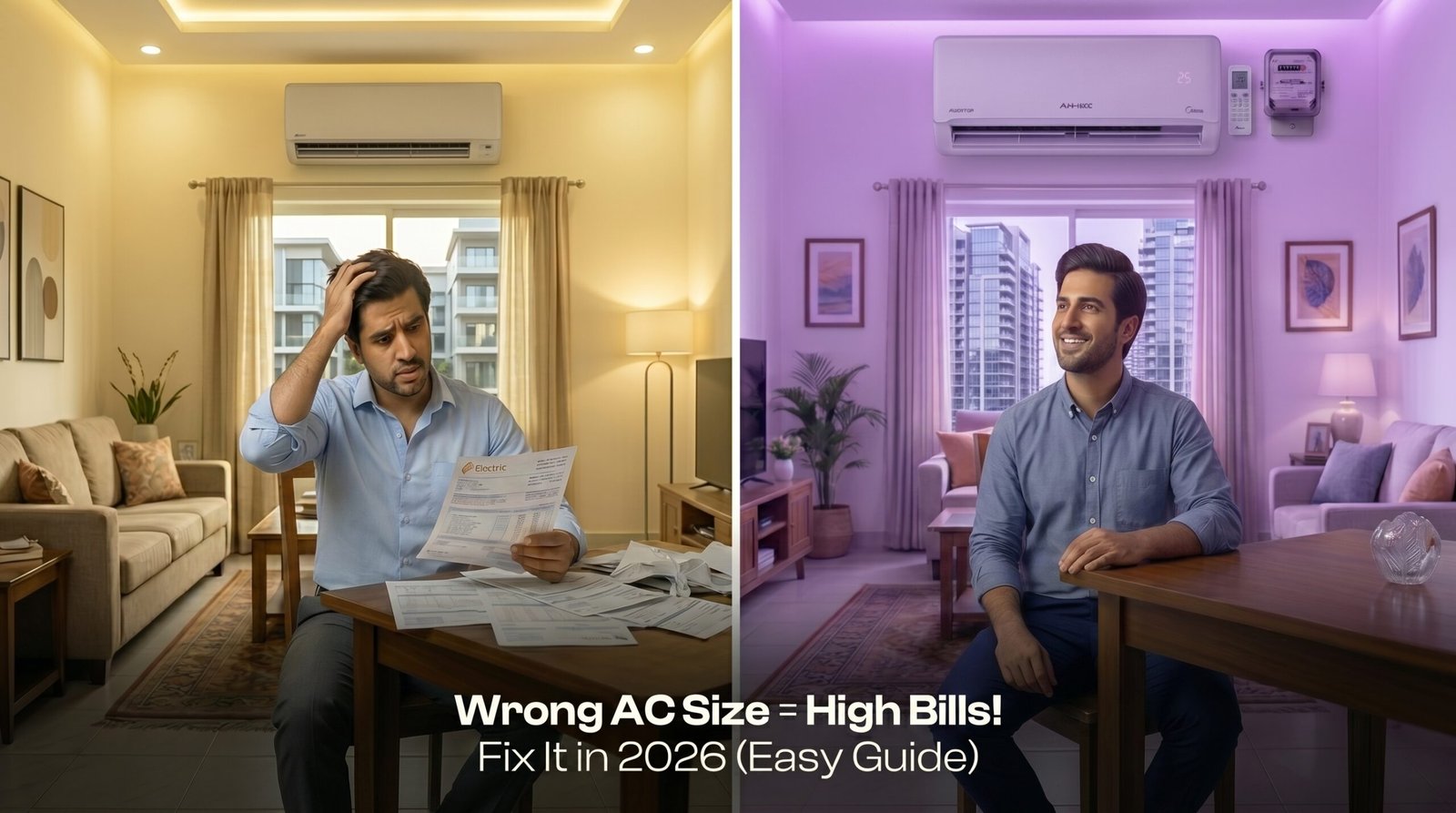
Wrong AC Size = High Bills! Fix It in 2026

The Ultimate Pakistani Buying Guide
Buying an air conditioner is one of the most significant household investments you will make in Pakistan. With electricity tariffs reaching record highs in 2026, making an uncalculated decision can cost you heavily for years to come. Unfortunately, a vast majority of buyers skip the math entirely. They walk into a retail store or browse online, pick a unit based purely on a salesperson’s recommendation or a vague guess, and hope for the best.
This guesswork often leads to immediate regret. If your air conditioner’s cooling capacity is mismatched with your room’s requirements, you will face a cascade of problems: inefficient cooling, short-cycling, excessive wear and tear on expensive components, and astronomical electricity bills that strain your monthly budget.
The Core Fundamentals—What Does AC “Size” Actually Mean?
Before diving into charts and calculations, it is critical to dispel a very common misconception prevalent in Pakistani appliance markets.
The Common Myth: Many consumers believe that a “1 Ton” or “2 Ton” AC refers to the physical weight of the indoor or outdoor unit.
The Reality: AC tonnage has absolutely nothing to do with physical weight. It is a scientific measure of cooling power—specifically, the amount of heat an air conditioner can extract from a space within a one-hour period.
The term originates from the historical practice of using ice for refrigeration. A “1 Ton” air conditioner has the cooling capacity equivalent to the amount of heat required to completely melt one ton (2,000 pounds) of ice over the course of 24 hours.
Understanding BTUs (British Thermal Units)
Here is the baseline conversion standard used across the industry:
AC Tonnage | Nominal Cooling Capacity (BTU/hour) | Average Heat Extraction Power |
1.0 Ton | 12,000 BTU/hr | Ideal for compact spaces and individual rooms. |
1.5 Ton | 18,000 BTU/hr | The standard baseline for medium residential rooms. |
2.0 Ton | 24,000 BTU/hr | Engineered for large master bedrooms and lounges. |
2.5 Ton+ | 30,000+ BTU/hr | Designed for massive commercial spaces or open halls. |
The Definitive Pakistani Room Sizing Chart
While custom environmental variables play a significant role, you need a reliable baseline to begin your search. The matrix below provides a standardized breakdown optimized specifically for typical residential and commercial construction standards across Pakistan.
Baseline AC Sizing Matrix
Room Area (Square Feet) | Typical Room Dimensions (Feet) | Recommended Baseline Capacity | Best Suited For (Standard Application) |
Up to 120 sq ft | 10 × 10 ft, 10 × 12 ft | 1.0 Ton (12,000 BTU) | Small kids’ bedrooms, home offices, server rooms |
120 to 180 sq ft | 12 × 12 ft, 12 × 15 ft | 1.5 Ton (18,000 BTU) | Standard master bedrooms, mid-sized TV lounges |
180 to 260 sq ft | 14 × 15 ft, 16 × 16 ft | 2.0 Ton (24,000 BTU) | Large drawing rooms, open-plan dining halls |
260 to 350 sq ft | 15 × 20 ft, 18 × 18 ft | 2.5 Ton (30,000 BTU) | Executive commercial offices, combined living spaces |
350+ sq ft | Multi-room or large halls | Multiple Units / Centralized | Banquets, commercial showrooms, mega residences |
Note: This chart assumes a standard ceiling height of 10 to 11 feet. If your ceiling height is greater, or if you live in an area with extreme thermal conditions, your requirements will change. Let’s look closely at those specific variables.
Critical Environmental & Structural Factors in Pakistan
1. Solar Exposure and Directional Orientation
The direction your room’s external walls and windows face dictates its daily thermal load.
- West-Facing Rooms: These are thermal traps. They absorb the intense, punishing heat of the afternoon sun right when ambient outdoor temperatures peak.
- East-Facing Rooms: These receive morning sunlight but cool down significantly by afternoon.
- The Rule of Thumb: If your room faces directly West or South and lacks external shading, you must add at least 10% to 15% more BTU capacity to prevent the compressor from running continuously without reaching the thermostat target.
2. Vertical Positioning (Top-Floor vs. Ground-Floor)
In Pakistan, multi-generational double-story or triple-story homes are highly common.
- A ground-floor bedroom is insulated by the floor above it, keeping it inherently cooler.
- A top-floor room or a single-story home with a roof directly exposed to the sun acts like an oven. Concrete slabs absorb thermal energy all day and radiate that heat downward into the room throughout the night.
- The Adjustment: For top-floor installations, increase your calculated BTU requirement by 15% to 20%. Failing to do so means a 1.5-ton unit might behave like a weak 1-ton unit in the peak of June.
3. Regional Microclimates (Coastal vs. Arid Plain vs. Sub-Tropical)
An AC unit that performs beautifully in the mild climate of Islamabad can struggle severely under the intense heat of Multan or the stifling humidity of Karachi.
- High-Humidity Zones (e.g., Karachi, Gwadar): The air carries immense moisture. The AC must spend significant energy condensing water vapor out of the air before it can effectively lower the temperature.
- Extreme Heat Zones (e.g., Lahore, Faisalabad, Multan, Sibi): Ambient temperatures regularly breach 45°C to 50°C. Standard compressors fail or trip under these conditions. You must look for units explicitly equipped with T3 Tropical Inverter Compressors, which are rated to sustain cooling cycles even when outdoor ambient temperatures reach 55°C.
4. Occupancy Densities
Every human body is a natural heat radiator, generating roughly 400 to 600 BTUs of thermal energy per hour. A bedroom shared by a couple requires far less cooling capacity than a TV lounge or drawing room where family members gather in large numbers every evening.
5. Glazing and Wall Insulation
Large, single-pane glass windows are thermal weak points. If your room features expansive glass windows without thermal tinting or heavy black-out curtains, heat infiltration will skyrocket. Poorly sealed doors and gaps around old window frames allow cool air to escape continuously, driving up electricity consumption.
The Step-by-Step Sizing Method
To find your room’s baseline, first calculate your total floor space by multiplying the room’s length in feet by its width in feet. Once you have the total square footage, multiply that number by 20 to get your base BTU requirement.
From there, adjust the base number according to your room’s specific layout and conditions:
- Sun Exposure: If the room is heavily exposed to sunlight, add 10% to the base BTUs.
- Top-Floor Position: If the room is directly beneath an uninsulated concrete roof, add 15% to 20% to the total.
- High Occupancy: Add 600 BTUs for every additional person beyond the second regular occupant.
- High-Heat Appliances: Add 1,000 BTUs if the room houses heat-generating electronics like large plasma displays, desktop gaming rigs, or refrigerators.
Real-World Calculation Scenarios
Let’s apply this method to three typical Pakistani residential layouts to see how it works in practice.
Scenario A: The Standard Middle-Floor Bedroom in Lahore
For a standard room measuring 12 feet by 14 feet, the total area comes out to 168 square feet. Multiplying this by the baseline factor of 20 gives a base requirement of 3,360 BTUs. Since this room is on a middle floor with standard sunlight and low occupancy, no extra environmental adjustments are needed. Because 3,360 BTUs is well within the limits of a standard small unit, a 1.0 Ton Inverter AC (which provides 12,000 BTUs) is more than sufficient and will run efficiently at low power levels.
Scenario B: The Punishing Top-Floor Master Bedroom in Karachi
Take a larger master bedroom measuring 14 feet by 16 feet, giving a total area of 224 square feet. The base calculation requires 4,480 BTUs. However, because this room sits directly under a hot roof, we must add a 20% top-floor modifier, which contributes an extra 896 BTUs. On top of that, heavy afternoon sun exposure through a West-facing window adds another 10% modifier, or 448 BTUs. This brings the true requirement up to 5,824 BTUs. While a 1.5 Ton unit might look like enough on a basic chart, these real-world environmental factors bring it right up to the limit. To ensure comfortable cooling during peak summer afternoons, a high-end 1.5 Ton Inverter AC with a robust T3 compressor is the best fit.
Scenario C: The Multi-Generational TV Lounge in Multan
Consider a large, open family lounge measuring 18 feet by 20 feet, which gives a total area of 360 square feet. The base cooling load starts at 7,200 BTUs. Since this is a central gathering space with an average occupancy of 6 people, the extra 4 occupants add 2,400 BTUs to the load. Additionally, heat from an open kitchen connection and a large television adds another 1,500 BTUs. This brings the final adjusted requirement to 11,100 BTUs. This space requires heavy-duty cooling power. You should install a 2.0 Ton Inverter AC or consider splitting the load across two 1.0 Ton units for better air distribution.
The Costly Consequences of Missing Your AC
Many buyers think that getting the size slightly wrong isn’t a big deal, assuming the unit will eventually cool the room anyway. In reality, choosing an incorrect size can significantly impact your wallet and comfort.
The Pitfalls of an Undersized Air Conditioner
When a consumer buys a 1.0 Ton AC for a room that actually requires a 1.5 Ton unit usually to save on the initial purchase price—they fall into a costly trap:
- Non-Stop Compressor Strain: The AC will run at maximum speed continuously, trying to reach a target temperature it cannot physically hit.
- Astronomical Energy Consumption: Because inverter units save money by slowing down once a room is cool, an undersized unit that never slows down will consume more electricity than a correctly sized larger unit.
- Premature Hardware Failure: Running at maximum capacity causes premature wear on the compressor, coils, and fan motors, leading to expensive repairs well before the warranty period ends.
The Pitfalls of an Oversized Air Conditioner
Some buyers choose an oversized unit (e.g., putting a 2.0 Ton AC in a small 10×11 study) thinking it will cool the room instantly. This creates a different set of problems:
- The Cycle of Short-Cycling: The oversized unit dumps an enormous volume of freezing air into the room, hitting the thermostat target within minutes. The compressor immediately shuts down. A few minutes later, the room warms slightly, and the compressor restarts with a high spike in power draw.
- Clammy, Humid Indoor Air: Air conditioners remove humidity by passing air slowly over cold evaporator coils, allowing moisture to condense. Because an oversized unit turns off so quickly, it fails to dehumidify the space. You are left with a room that feels cold but uncomfortably damp and clammy.
- High Operational Costs: The initial power surge required to start a compressor repeatedly consumes more electricity than a correctly sized unit running smoothly at low speeds.
Inverter vs. Non-Inverter Sizing Mechanics
The Definitive Answer: No. The required cooling capacity of your room does not change based on the technology inside the air conditioner. A room that needs 18,000 BTUs of heat removal will always need 18,000 BTUs, regardless of the type of unit installed.
Understanding the Functional Difference
The difference lies entirely in how each technology delivers that cooling power:
- Non-Inverter AC (Fixed Speed): Operates on an all-or-nothing basis. The compressor runs at 100% speed until the room reaches the set temperature, then shuts off completely. When the temperature rises, it restarts at 100%. This cycling causes noticeable temperature swings and draws a large amount of power each time it restarts.
- Inverter AC (Variable Speed): Uses an intelligent variable-frequency drive to precisely control the speed of the compressor motor. It starts at full speed to cool the room quickly, then throttles down to a low, continuous speed (often drawing just 200 to 400 watts) to maintain that temperature perfectly.
This ability to run continuously at low power is why inverter models save significant amounts of electricity. However, to benefit from these savings, the unit must be sized correctly. An incorrectly sized inverter will behave like a fixed-speed unit, losing its primary advantage.
2026 Electricity Consumption & Tariff Breakdown
With Pakistan’s current electricity pricing tiers, running an air conditioner requires careful budget planning. The table below provides an estimated look at power usage and costs across different sizes, based on an average of 8 hours of daily operation.
Estimated Operational Cost Breakdown
AC Unit Sizing | Average Power Consumption (Units/Hour) | Monthly Unit Accumulation (8 Hrs/Day) | Estimated Monthly Bill Contribution (PKR Range) |
1.0 Ton Inverter | 1.0 – 1.2 Units | 240 – 288 kWh | Rs. 8,000 – Rs. 12,000 |
1.5 Ton Inverter | 1.5 – 1.8 Units | 360 – 432 kWh | Rs. 12,000 – Rs. 18,000 |
2.0 Ton Inverter | 2 – 2.5 Units | 480 – 600 kWh | Rs. 18,000 – Rs. 25,000 |
Disclaimer: These calculations are estimates based on standard residential electricity rates in 2026. Your final bill will depend on your total monthly household consumption tier, whether you are on a peak/off-peak tariff structure, your specific thermostat settings (26°C vs 18°C), and the energy efficiency rating (EER) of your unit.
Ultimate 2026 Product Guide (By Room Size)
1. Best 1.0 Ton Inverter ACs (For Spaces up to 120 sq ft)
These compact models are ideal for smaller bedrooms, home offices, and study areas where energy efficiency and quiet operation are top priorities.
Brand & Model Designation | Retail Price (Estimated) | Ideal Use Case | Key Features & Technical Specifications |
• Up to 60% rated energy savings • Integrated Smart WiFi + Voice Control modules | |||
Dawlance 1 Ton Inverter (Mega T3 Pro 15) | Rs. 125,000 | High thermal zones (Lahore, Multan, Sukkur) | • True T3 tropicalized dual-inverter compressor • Year-round heat & cool functionality • Gold-fin anti-corrosive condenser coating • 12-year extended compressor warranty |
• High-efficiency DC inverter technology • Turbo fast-cooling initialization mode • Extended multi-directional air throw |
2. Best 1.5 Ton Inverter ACs (For Spaces from 120 to 180 sq ft)
As the most popular size in Pakistan, these mid-sized units offer an excellent balance of cooling capacity and energy-saving technology for standard master bedrooms and living rooms.
Brand & Model Designation | Retail Price (Estimated) | Ideal Use Case | Key Features & Technical Specifications |
• Premium T3 tropical digital compressor • Low-voltage startup stabilization (down to 150V) • Extended-reach aerodynamic air throw | |||
Hisense 1.5 Ton Inverter (18DC60HC) | Rs. 134,900 | Light sleepers, quiet office spaces | • Ultra-quiet operation acoustics • High-speed rapid cooling tech • Advanced 6S inverter efficiency monitoring • Multilayer medical-grade air purification filters |
Midea 1.5 Ton Inverter (Extreme 18-HRFN) | Rs. 155,000 | Daily high-usage spaces where energy savings matter most | • Up to 70% certified structural energy savings • Extreme wide voltage protection window (99V–260V) • Robust high-ambient T3 performance stability • Highly durable chassis built for long life |
3. Best 2.0 Ton Inverter ACs (For Large Spaces over 180 sq ft)
Designed for large, open architectural spaces like formal drawing rooms, main family lounges, and commercial spaces.
Brand & Model Designation | Retail Price (Estimated) | Ideal Use Case | Key Features & Technical Specifications |
• Eco-friendly R32 refrigerant gas platform • Extremely stable voltage handling under fluctuating loads • High-volume CFM airflow delivery systems | |||
• Industry-leading flagship inverter system architecture • High-capacity dual heat & cool performance cycles • Seamless WiFi smart integration and remote tracking | |||
Kenwood 2 Ton Inverter (KES-2473S) | Rs. 220,000 | Long daily operation, large open spaces | • Real-world energy saving efficiency metrics up to 60% • Intelligently designed rapid cooling turbo modes • High-tolerance wide voltage operational safety net • Heavy-duty golden fin hydrophobic heat exchanger coating |
Common Buying Mistakes to Avoid
- Choosing Solely Based on Upfront Price: Buying a cheaper, low-efficiency model can cost you far more in electricity bills over the first two seasons than the money you saved on the initial purchase.
- Ignoring the Inverter’s Operating Range: Many budget inverter units only modulate down to 50% capacity. Premium models can drop to 15% or 20% capacity, offering much better savings over time.
- Neglecting Room Insulation and Air Leaks: Installing a high-efficiency AC in a room with open windows, loose doors, or unshaded glass panels forces the unit to work overtime, wasting its energy-saving benefits.
- Skipping Regular Maintenance: Failing to clean your indoor unit’s dust filters every two weeks and ignoring the annual chemical wash routine can reduce your system’s efficiency by up to 30%.
Final Thoughts
Frequently Asked Questions (FAQs)
Q1: Can I install a 1.0 Ton AC in a large living room to save on electricity? +
Absolutely not. Doing this will create the opposite effect. The 1.0 Ton unit will not have enough capacity to cool the large space, forcing its compressor to run at maximum speed continuously. Your room will remain uncomfortably warm, and your electricity bill will skyrocket.
Q2: My room measures exactly 12×12 feet. What is the ideal size for it? +
For a standard 12×12 space (144 square feet), a 1.0 Ton AC is usually perfect. However, if the room is on a top floor or faces directly West, you should upgrade to a 1.5 Ton unit to handle the extra heat load.
Q3: Does an inverter AC allow me to buy a lower tonnage model? +
Q4: What is the maximum square footage a 1.5 Ton AC can comfortably cover? +
In Pakistan's climate, a 1.5 Ton AC can comfortably cool an area between 120 and 180 square feet, depending on factors like sun exposure, floor level, and room insulation.
Q5: Is buying a larger AC than required always the best option? +
No, it is not. An oversized unit will cool the room too quickly and shut off before it can properly remove moisture from the air. This results in a cold but uncomfortably damp and humid room, along with higher energy consumption from constant restarting.
Q6: Does a larger AC always lead to higher electricity costs? +
Not necessarily. If a slightly larger AC matches your room's heat load perfectly, it can cool the space quickly and throttle down to low power sooner, saving money. However, if the unit is drastically oversized, the frequent on/off cycling will increase your power bills. Sizing it correctly is always the best approach.
Q7: What is the "3-Minute Rule" for air conditioners, and why does it matter? +
Q8: What are the main signs that my current AC is oversized? +
You can easily spot an oversized AC by looking for a few clear signs:
- The unit turns on and off frequently throughout the hour (short-cycling).
- The room temperature drops very quickly, but the air still feels heavy, damp, and humid.
- You experience sudden temperature swings, feeling freezing cold one minute and uncomfortably warm the next.
- Your electricity bills are unusually high compared to similar households.